Music composition for kids: Why writing songs matters
Music composition develops creativity, emotional expression, and confidence in kids as young as five. Here's why writing songs belongs in piano lessons and how we teach it at Payam Music
Most piano lessons train children to learn pieces from other composers and eventually perform. I think they should also teach children to create.
Composition is the missing piece in piano lessons
There's an important difference between learning to play music and learning to make music. Most piano lessons train children to faithfully reproduce notes that someone else wrote down, often from decades (to hundreds!) of years ago. Currently, there are not a lot of options for children to learn how to create music on the piano. Writing music can be intimidating but it’s also incredibly rewarding! Nothing’s more satisfying than creating a song that didn't exist before you sat down at the piano.
At Payam Music, composition is intentionally built into our curriculum from the earliest levels. Our students learn to play and to write music from the beginning.
Traditional piano teaches to play, not to create
The standard approach to teaching piano is, in many ways, black and white. A child sits at the keys with a songbook in front of them and plays music exactly as written. There's beauty and value in that discipline. The student’s job is to deliver it faithfully, with little room for personal interpretation or creativity.
Composition flips that relationship. When a student writes their own song, even a short and simple one, they go from interpreter to author. They choose the melody. They decide what comes next. They learn that the techniques they've practiced on other people's music are tools they use for their own ideas.
How music composition develops creativity in children
Beyond the joy of making something original, composition develops the kind of thinking that’s increasingly more valuable.
A focus on “soft skills” like creativity, critical thinking, communication, and collaboration are no longer considered optional. As artificial intelligence keeps getting better at tasks that follow patterns, the human skill that holds its value is the one that starts with a blank page.
Music composition happens to be one of the few activities available to young children that trains both halves of creative thinking at once: divergent thinking (exploring many possible ideas) and convergent thinking (choosing the best one and refining it). A child composing a song does both, over and over: try a melody, play another, decide which feels right, change a note, play it again. Performance trains discipline and precision. Composition trains the full creative process!
How composing music helps kids process emotions
Beyond the cognitive argument, there's a benefit our instructors notice every week in class.
Children constantly experience emotions they don't yet have words for. Songwriting gives kids a structured, healthy way to process feelings that don't fit easily into a conversation. As I’ve seen in my own students, expressing thoughts and feelings through a song is often easier than expressing them through words.
My passion and love for piano grew deeply once I began composing at age nine. Songwriting became one of the most important things in my life, and is the core reason I was able to develop the Payam Music notation and curriculum. For me, composition turned piano from just being an instrument into becoming my best friend. No matter what life threw at me, I knew I could turn to the piano and let my emotions loose. I would sit and compose for hours. The piano healed me and served as my outlet.
When you learn to write songs, the piano isn't just an instrument anymore. It becomes a place to work through feelings. A parent of one of our students told me, “I can tell what kind of day she’s had by how she plays the piano after school.”
How we teach composition at Payam Music
Most piano lessons don't teach composition at all, and even fewer teach it to children as young as five. I think that's a missed opportunity. Composition is teachable, but it requires a curriculum designed around it, instructors trained in it, and a notation system that lets young children get to the creative part quickly.
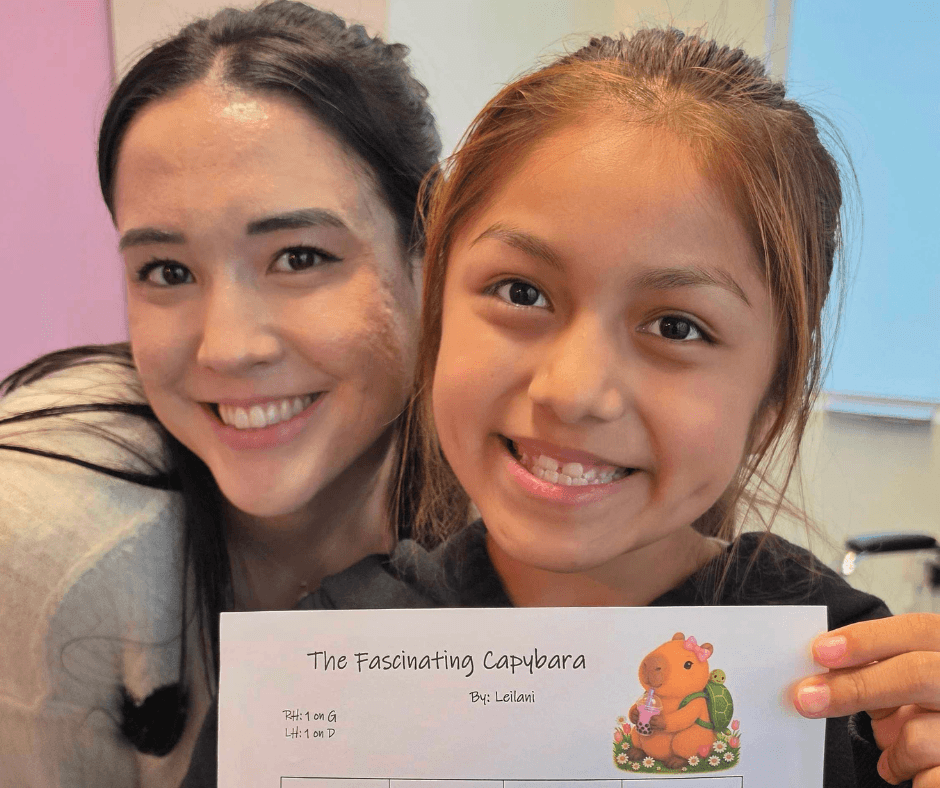
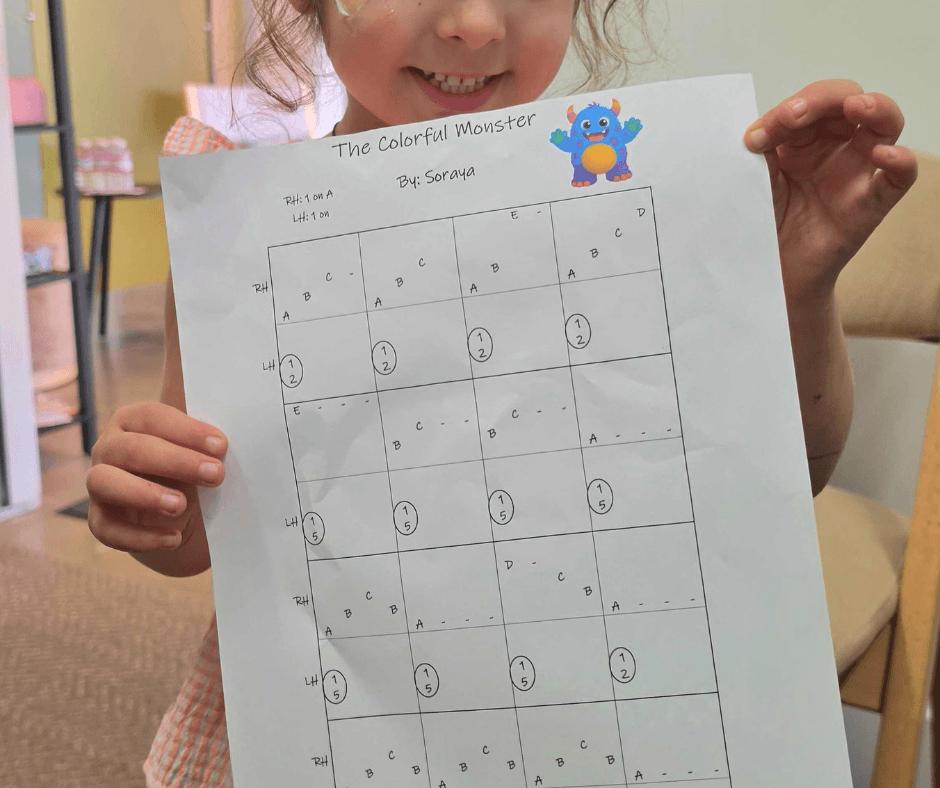
Our alphanumeric notation, the foundation of the Payam Method, makes composition accessible early. A five-year-old who hasn't yet learned to read traditional sheet music can still sequence ABCs and 123s into a melody of their own. From there, students learn techniques from other composer’s songs and then apply those techniques to their own compositions, building a real catalog of original work over time.
I didn't have the privilege of an instructor to teach me composition. I had to learn it on my own. So I wanted to make sure that every student at Payam Music who wants to learn composition has the opportunity to. That's why we built an entire curriculum to scaffold the songwriting experience.
That said, while we teach all of our students to compose, we don’t force it upon them. Some kids fall in love with the great composers and want to spend their time playing that beautiful music. Others light up the moment they're inventing something of their own. Some people love reading books, others love writing their own stories. Both are real forms of engagement. Our job as piano instructors is to expose our students to all possibilities and let them blaze their own path.
Ownership builds confidence
A child who plays a piece beautifully has done something impressive. It takes practice and dedication to play a song as the composer intended. A child who plays their own song — and can tell you what it's about and why they wrote it — has done something different. They've made something that didn't exist before, and get to experience the joy of ownership.
“I think my favorite piece to play on the piano is my own composition, ‘Pieces of Belonging.’ I like that it reflects on belonging and it makes me feel like I fit in or it makes me feel like I’m in the right group and it makes me feel warm and loved.”
A six-year-old playing a Bach minuet at a recital is worthy of our applause. A six-year-old performing a song they wrote themselves, however, is unforgettable. The look on their face when the audience claps for something they invented becomes a part of their sense of self for years to come.
Real recognition: National awards in composition
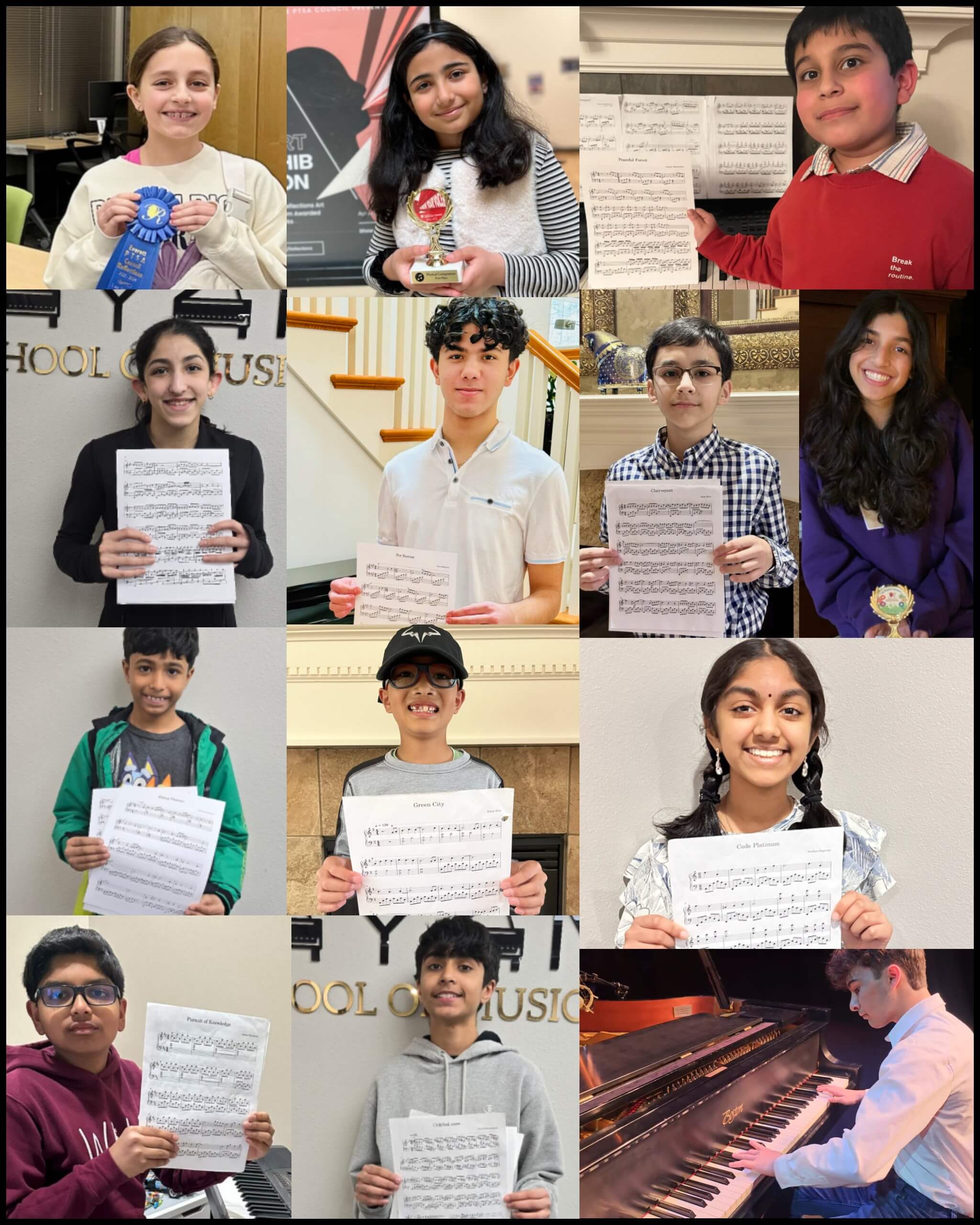
We're not the only ones who think children's compositions deserve to be taken seriously.
The PTA Reflections competition is a national arts program that hundreds of thousands of students across the US compete in each year, including in the music composition category. In 2025, Payam Music students competed against students nationally and won 4 out of 5 first-place spots in Washington State, and a Payam Music student won first place nationally in composition. It's strong evidence that with the right curriculum, even young children can produce original music that holds up against the country's best.
The joy of falling in love with piano
The piano either speaks to you, or listens to you.
A child who plays other composers' work has a piano that speaks to them and that's a real gift. There are countless benefits to learning to play the piano. A child who also writes their own music has a piano that listens. They understand how to create something that didn’t exist before. I strongly believe that there is tremendous value in playing and composing. We just think more kids deserve the chance to find out which one they love more.
Curious whether your child would love writing their own songs? Schedule a trial lesson at any Payam Music location.
FAQs: Teaching composition to young children
At what age can children start composing music?
Children as young as four can begin composing simple melodies, especially with a curriculum and notation system designed for early learners. The Payam Method uses alphanumeric notation that lets young students sequence notes into original songs before they can read traditional sheet music. The first compositions are simple — a few bars, with names like "My Cat is Sleepy" — but the creative process is real, and the work grows with them over time.
What's the difference between composition and improvisation?
Improvisation is making music up in the moment, often within a structure. Composition is the process of writing a piece down (or recording it) so it can be performed again later. Both develop creativity, but composition specifically trains the planning, revision, and refinement skills that researchers call convergent thinking: the ability to take many ideas and shape them into one finished piece.
Does learning composition replace traditional piano instruction?
Not at all. At Payam Music, composition is taught alongside playing. Students still learn techniques, read traditional sheet music, and study pieces by the great composers. Composition gives them somewhere to apply what they've learned and an outlet for their own ideas.
What if my child doesn't want to compose?
That's completely fine! We don't push every student into composition. Some children prefer to focus on playing the works of great composers, and that's a meaningful path on its own. Others discover composition is the part of piano that makes them light up. Our curriculum gives students access to both and lets them follow what they're drawn to.
Will my child write a real song or just exercises?
Real songs. Many of our students perform their own compositions at our recitals, and several have won national-level recognition through the PTA Reflections competition. The work is original and their own.
What are the benefits of teaching kids composition?
Composition develops divergent and convergent thinking, gives children a structured outlet for emotional expression, builds confidence through creative ownership, and strengthens executive function skills like planning, working memory, and revision. Research from Northwestern University, USC's Brain and Creativity Institute, and the AMA Journal of Ethics all point to measurable benefits across cognition, mental health, and identity development.
Is composition harder to teach than playing?
It's different, not harder. Composition requires a curriculum that scaffolds the creative process step by step rather than just teaching pieces that exist. That's why so few piano schools teach it. We've spent years building a curriculum, training teachers, and developing a notation system specifically to make composition accessible — including for very young children.
Can my child learn to compose at Payam Music if they're already taking traditional lessons elsewhere?
We only teach composition to students enrolled at Payam Music. We don’t have a composition-only option for students who are not already enrolled in weekly lessons.